




Ocean Habitat Restoration · Bocas del Toro, Panama

Building a City Beneath the Sea

Scroll
Key Findings
0

Artificial reef structures built and sunk across the archipelago since 2019.

0

Coral fragments outplanted by Caribbean Coral Restoration.

Keystone species

Nurse sharks and a Caribbean king crab colony have returned to Nayara's sites, the surest sign the system is alive again.

The Foundation of Ocean Life

A city is built foundation first

First come the structures. Then the mobile residents arrive, fish through the corridors, crustaceans in the crevices. Finally the permanent residents settle: coral. Once attached, it cannot leave. It is not a visitor. It is the city.

0
of the ocean floor is coral reef
0
of all marine species depend on it
0
people's livelihoods rely on reefs

Reefs occupy a sliver of the sea yet anchor a quarter of its life, and they are the ecosystem most directly, most irreversibly affected by what the ocean is doing right now.

The Global Context

The most severe bleaching event ever recorded

Each global bleaching event was called the worst in history. What is happening now is not a continuation of that trend, it is a different order of magnitude, and it is still ongoing.

1998
21%
2010
37%
2014–17
68%
2023–
84.4%

Scientists identify 1.2 °C of warming as the effective tipping point for warm-water reefs. The planet is at that threshold now. Restoration cannot reverse what the ocean is absorbing, but it can buy time, preserve genetic diversity, and rebuild the conditions for recovery. That is the honest framework. Everything here operates inside it.

Why Bocas del Toro

A refuge of what the Caribbean is losing

The Bocas del Toro archipelago holds roughly 87% of every reef-building coral species documented in Panama, one of the most significant marine research sites in the western hemisphere, per the Smithsonian.

Crucially, much of the reef loss here is driven by hypoxia from runoff and sewage, a local problem with local solutions, unlike global heat. And the mangrove lagoons act as genuine refugia: corals grown there keep their heat tolerance even after a year on the open reef.

These waters aren't postcard-blue. They're turbid, warm, nutrient-rich from the mangroves that feed them. That isn't a weakness, it's the engine that lets coral grow faster here than almost anywhere in the Caribbean.

Aerial view of Nayara Bocas del Toro overwater villas, mangroves and reef at sunset
Mangrove, seagrass and reef, one integrated system above Bahía Almirante.
The Partnership

From a small island, outward

Caribbean Coral Restoration is a nonprofit on Isla Solarte, founded by a civil engineer who has lived in Bocas for over 16 years. He didn't come to start a restoration organization. He came for the water, and started the work because of what was happening to it.

0
coral nurseries established
0
fragments outplanted (2019–22)
0
reef structures built & installed

Seven reef-building species, eight collection sites, and five Indigenous Ngäbe workers employed to build and sink the structures, a direct economic link between reef recovery and the communities whose lives depend on this water. The team also drove Bocas del Toro's recognition as a Mission Blue Hope Spot.

"The corals that survive are not random. They are the ones this reef will rebuild itself around, if we give them the conditions to do it." Founder, Caribbean Coral Restoration
The Founder · Doug Marcy

Saddle to surf

Doug Marcy grew up on horseback in the Nebraska Sandhills, about as far from the ocean as North America allows. An engineering scholarship handed him an unlikely elective, scuba over parachuting, and in 1972, on his first ocean dive off a Florida dock, he sat on the seafloor and watched fish move through the light like living stained glass. The moment never left him.

Nearly forty years later it carried him to Bocas del Toro, where he watched vibrant reefs fall silent within months. So he turned a civil engineer's training toward rebuilding marine ecosystems from the ground up, the work that became the Caribbean Coral Restoration Center. Barren zones filled again with plankton, then fish, then predators, and finally coral that began settling on its own.

"The ocean still remembers how to heal. Our responsibility is to give it that chance."Doug Marcy, Founder · Caribbean Coral Restoration
The Science

Four methods, working together

The goal is no longer a tally of transplanted corals. It's biodiversity and biomass, tracked structure by structure, rising as each ecosystem matures.

01

Resilience selection

Corals that have already proven they can adapt are brought into a protected facility, the foundation of everything downstream.

02

Assisted spawning

Technology used by only ~60 organizations worldwide induces spawning, raises offspring, and releases them at restoration sites.

03

Translocation

Compatible specimens are brought within breeding range. They must be regionally sourced, even the same species elsewhere has adapted differently.

04

Elevated structures

Lifting coral even two feet off the degraded seabed sharply raises survival. Materials are chosen for low carbon footprint and longevity.

The Waters of Bocas

A mosaic of living waters

No two waters in the archipelago look alike. Clear reef passes give way to turbid mangrove lagoons, and nutrient-rich channels run between islands cloaked in seagrass. The footage here moves through that range, from open blue to the green, plankton-thick shallows where coral grows fastest.

That variety is the point. Each environment shelters different life and asks something different of the coral within it, which is why restoration here is done site by site rather than one-size-fits-all. Even the mangrove lagoons, long dismissed as marginal, turn out to be refuge: corals raised there keep their heat tolerance out on the open reef.

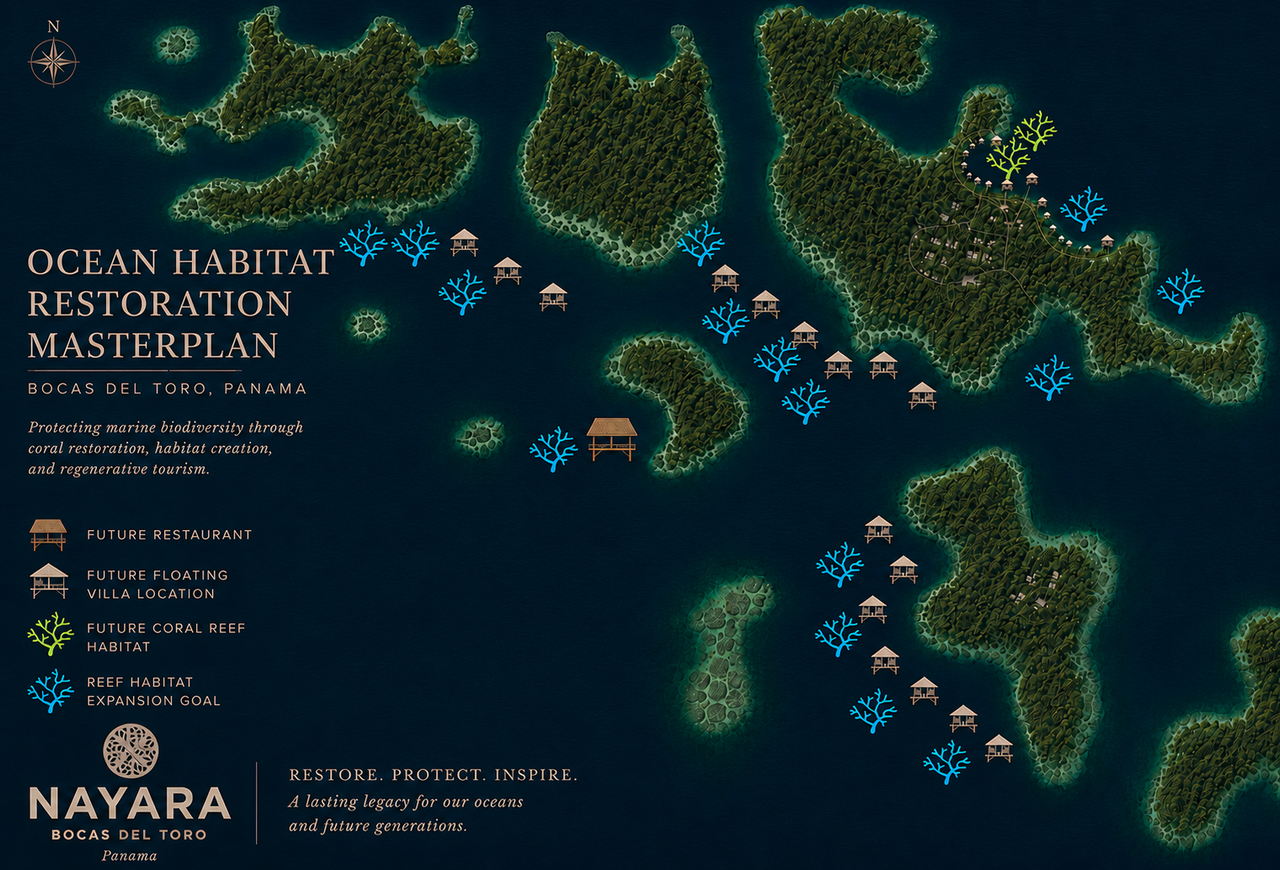
Within this mosaic, Nayara Bocas del Toro began in the bay below its overwater villas, ten structures seeded with coral that survived the 2020 bleaching, with fish returning within a year, and is now expanding outward across the islands.

The shifting character of the water across the Bocas del Toro archipelago.

Across those waters: 17 habitats, in three phases

Phase One · Live

Beneath the villas

Structures placed directly under the overwater rooms, now recognized as awareness infrastructure guests witness every day of their stay.

Phase Two · Live

Just past the property line

A real reef established outside the boundary, already showing measurable gains in biodiversity and biomass.

Phase Three · Planned

Net-zero floating villas

Structures between the floating villas, engineered as coral offsets, a completely net-zero, net-positive villa.

Nurse sharks patrolling a restoration site.
The Proof

When the sharks come back, you know it's working

This is coral habitat restoration, not just reef restoration, and the distinction matters. Healthy coral is what lets everything else return.

Nurse sharks and other keystone species are back at Nayara's sites. Predators only appear once their prey returns, and prey only returns once the coral does. One habitat even became home to a Caribbean king crab colony: a first the founder had never seen in decades of reef work.

The Vision

One continuous reef across the archipelago

Not isolated patches, a living corridor connecting the whole of Bocas del Toro. If a resort can prove its operations actively restore the ecosystem it sits within rather than merely minimizing harm, it changes the calculus for the entire industry.

Luxury and restoration, the project argues, are not in tension. They are the same thing.

Be Part of It

Sink a reef, then watch it live

The most personal part of the program turns guests into builders. You will not only visit the reef. You will help create a habitat, then follow the one you started as it comes alive over the years.

01

Place it yourself

On a guided snorkel, you help lower a reef structure onto the seabed alongside the restoration team and seed it with resilient, bleaching-tested coral.

02

Watch it come alive

Fish move in within days. Sponges and invertebrates follow, more selective, assessing before they commit. Coral settles across the seasons after.

03

Track it for years

Every structure is logged and monitored, its biodiversity and biomass recorded over time, so the habitat you seeded becomes something you return to and follow as it matures.

DaysFish arrive
WeeksInvertebrates settle
2 to 3 yearsCoral takes hold
OngoingA living habitat
Frequently Asked Questions

Questions we get asked

What is coral bleaching, and why is it accelerating?+
When water exceeds a coral's thermal threshold, it expels the symbiotic algae that feed and color it, turning white and starving. Cool down in time and it recovers; if not, it dies. A 2025 paper in Coral Reefs documented the current event as the most severe on record, heat accumulation 50% greater than any previous one.
Why does Bocas del Toro matter for restoration?+
It holds ~87% of Panama's reef-building coral species, and much of its reef loss comes from hypoxia and nutrient runoff, a local stressor that can be addressed independently of global ocean temperatures. That mix of genetic richness and fixable local variables makes it one of the most viable restoration sites in the Caribbean.
What is an artificial reef structure?+
An engineered form placed on the ocean floor to provide the substrate and habitat complexity degraded reefs no longer offer. Fish colonize them naturally, creating the conditions that support coral outplanting. Each structure costs roughly six thousand dollars to build and install.
What does "heat-resistant coral" mean in practice?+
Coral carrying traits that allow survival at temperatures that kill standard reef corals. Research in Nature Communications confirmed these traits are heritable across generations. The program propagates the genotypes that survived Bocas del Toro's 2020 and 2023 bleaching events.
Can guests take part in the restoration?+
Yes. Guided snorkel and dive experiences give direct access to the reef structures with expert interpretation, and an adopt-a-coral program lets guests fund new structures for the archipelago expansion. Contact the resort for details.
How does this connect to reforestation on land?+
Ecologically, healthy forests cut the runoff that carries sediment and nutrients into coastal reefs, protecting water quality downstream. Philosophically, both programs follow the same model: begin locally, prove what works, then expand outward.
Is coral restoration enough to save reefs?+
No. The 2025 Tipping Point Report is clear that restoration can't substitute for global emissions cuts. What it can do is maintain genetic diversity, preserve structure, and buy reefs time to survive long enough to benefit from the climate action that ultimately decides their future.
Sources
Further Reading
Experience It

We started in our backyard. We are not stopping there.

Every guest at Nayara Bocas del Toro can enter the reef, understand the science, and contribute to its recovery.

Skip to content

 Stay Informed as The Restoration Comes to Life